

 |
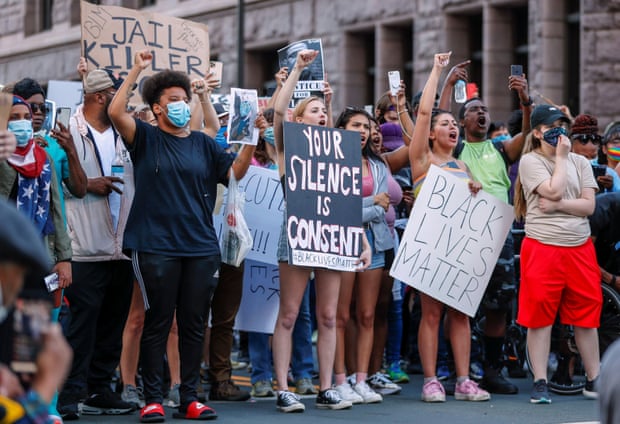
| Protesters gather outside the Hennepin county government center in Minneapolis, Minnesota, on 28 May. Photograph: Eric Miller/Reuters |
Riots in Minneapolis and across the US triggered by video footage showing George Floyd, a black man, killed under the knee of a police officer, has caused a dramatic shift in the national political debate in America and thrust race to the center of the stage.
Donald Trump and Joe Biden offered divergent responses that point to an even more divisive political debate on race relations and between Democrats and Republicans playing out in the months ahead.
The president, in a tweet in the early hours of Friday, warned that “when the looting starts, the shooting starts”. Later on Friday the former vice-president in a video address called for national unity and serious police reform, saying: “This is no time for incendiary tweets. This is no time to encourage violence. This is a national crisis, and we need real leadership right now.”
Shortly afterward at a separate press conference in the Rose Garden where the president seemed poised to follow up and further address Floyd’s death and the riots, Trump instead announced that the US would withdraw from the World Health Organization.
He did not mention the riots or Floyd’s death.
Meanwhile, Biden revealed he had already spoken to Floyd’s grieving family and spoke emotionally of the shock at his killing and society’s racial problems. “We’re a country with an open wound. None of us any longer can hear the words ‘I can’t breathe’ and do nothing,” he said.
The wildly different responses by the two men battling for the White House under the ongoing cloud of the coronavirus pandemic has left party leaders unsure of what exactly the final months of the presidential election will now look like.
But leaders and strategists agree on one thing: the months ahead are likely to be a bareknuckle brawl over what the most pressing problems facing the US are.
“The question is whether Democrats are going to adjust to the reality of what is going to be a brutal, vicious and mean campaign cycle and if we don’t, we’re going to lose,” said the former Atlanta mayor Kasim Reed.
Bakari Sellers, a former member of the South Carolina house of representatives, said: “The president usually thrives on culture wars. But I think this flame is probably going to engulf his presidency.”
Leah Daughtry, a veteran Democratic political operative, warned Trump’s late-night tweet on shooting looters was a deliberate attempt to incite his base of supporters rather than push for unity or any kind of de-escalation of tensions.
“I think the president’s tweet does what it’s intended to do and [was] directed to the audience it’s intended for him to reach … it’s clearly intended to incite and engage a particular part of his audience,” Daughtry said.
On Friday, Minnesota’s governor, Tim Walz, visibly frustrated, held an extended press conference where he called for healing and tried to address the long-simmering tensions that have erupted over Floyd’s death. At the same time, Walz also stressed the importance that he and other officials maintain order during the protests.
Continue Reading>>


No comments:
Post a Comment